Showing posts with label Storm of 1900. Show all posts

Friday, March 19, 2010

Part 2 of Dancing With the Storms

Part 2 [For Part 1, click here.]
One-Two-Three...One-Two-Three...
Lighthouse on Bolivar Peninsula, Texas.  2010

By 4 June 1900, Daniel, Annie and their five children [one of which is my 1st great-grandmother Boo] are living in Eagle Pass, Texas, which is no where near the coast. In fact, it's on the other side of the state on the Texas-Mexico border.  So why did they move?  I'm not real sure, but I do know one thing.  On 8 Sep 1900, they missed the single most devastating hurricane that has ever hit the United States coast.  That's right, the Storm of 1900.  [Obviously, we still hadn't started naming them yet.]   Everyone hears about the devastation that occurred on Galveston Island and the estimation of 8000 that perished from the storm because it was so much more populated, but since Bolivar Peninsula is so close to Galveston, it was devastated too.  Over 120 people used the lighthouse for shelter, but dozens didn't make it to the lighthouse and died.  In fact, the only ones that lived were the ones who had sought out shelter in the lighthouse on the Peninsula.  If Daniel and Annie had stayed, would they and their family have made it to the lighthouse?

Which kind of brings me back to why they moved.  

So far away from the coast.


View Bolivar Peninsula-Eagle Pass in a larger map

Also, how'd they get there?  Well, they didn't walk, and I don't think they went by wagon [but they very well could have].  But they may have gone another way.  You see, the Galveston, Harrisburg and San Antonio Railway had completed the railway to Spoffard, Texas then on to Eagle Pass in 1882.  After that it was extended into Piedras Negras, Mexico, the town on the opposite side of the border from Eagle Pass.  The completion of this railway facilitated exportation and importation of goods.
Photo courtesy of Texas Transportation Museum

Basically connecting the Port of Galveston with Mexico. 
And Eagle Pass' population soared [pardon the pun]. 

But why did Daniel and Annie leave Bolivar Peninsula?  Well, in the last census where the family is listed in 1880, Daniel is listed as a carpenter, and he's listed as being unemployed for the last 12 months. 

With his wife Annie. 

With their 2 year old son. 

And they were living in a boarding house.
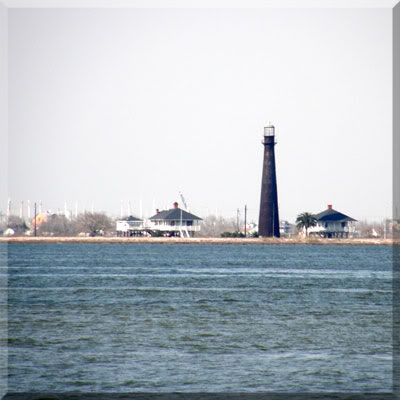
View of Bolivar Peninsula Lighthouse from ferry. 2010

Not being able to access the 1890 population schedule, I don't know what their lifestyle was like on the Peninsula in 1890.  Had it been any better?  Additionally, how much did his old fracture from the Civil War affect what Daniel could do physically?  I mean, at the time his leg was fractured in the Civil War did it get set immediately?  I dunno, but if things weren't looking too good financially and he got wind of the opportunities available in Eagle Pass, maybe he decided to risk it all and move his family.
Eagle Pass, Tx.,  1887 Bird's Eye View of Eagle Pass Maverick Co, Texas. 1887, 1887. Lithograph (hand-colored), 16 x 22 in., Lithographer unknown. Amon Carter Museum, Fort Worth. Gift of Mr. Charles Downing.  Photo Courtesy of Wikimedia Commons.
Of course, Eagle Pass [and the border in general] was not a very safe place to be.  You've heard of the wild west, haven't you?  Well, before the railway, Eagle Pass had a rough reputation.  Not exactly the best place in which to settle and raise your family.

So, it couldn't have been an easy decision for Daniel and Annie to make.  To leave what they knew and go to something they didn't know.  However, it was the right decision and not just because they had avoided the Storm of 1900.  In the 1900 census in Eagle Pass, Daniel was listed as a dry goods merchant.  Obviously taking advantage of the population growth due to the expansion of the railway in the border town.  They were renting their home, but they were in a home ~ not a boarding house. 

I wonder how Daniel and Annie reacted when they heard of the destruction made by the Storm of 1900 to the place they had called home for over 13 years?  Had they worried about those they had left behind?  Their friends?  I suspect they were counting their blessings when they finally heard the terrible news.

One-Two-Three...One-Two-Three...

The logical part of me says that of course they moved for the opportunity at a better life.

But a part of me wonders, though, if perhaps Daniel and Annie just had a 6th sense when it came to the Gulf Coast and hurricanes.

And what of his leg?  If it had bothered him when he lived on the Gulf Coast, did moving to a drier climate make it feel any better?

In any case, having the ability to look back on their lives, it seems to me that Daniel and Annie were very good dancers.

For they had danced with Mother Nature.

And were never voted off the show.

[Snort.]  Yes, I've seen the show Dancing With the Stars.  Unfortunately. 

Ironically, the first time was right after Hurricane Ike hit Galveston Island.  Our electricity and cable were still off, and with our generator, t.v., and rabbit ears, we were only able to tune-in clearly 2 English-speaking channels.  One evening after dinner [from a can], we settled down to watch some T.V.  What was on?  One channel had the news.  The other had Dancing With the Stars.  Since we were tired of watching and listening to news and since no one in my house speaks Spanish except for me, Dancing With the Stars won that night.

[rolling eyes heavenward]  Below is a small slide show of some of the photos I took yesterday on Bolivar Peninsula.  Most of the damage from Hurricane Ike is evident in not what is there, but what is not there.  The peninsula [which is a misnomer because it's actually not connected to the mainland by land but by a bridge on the other end] is clean, but bare.  They have a long way to go in rebuilding.  However as history reveals, they are not alone, for those who came before, had to rebuild too.


Saturday, August 1, 2009

Disasters: Not Today

Follow Me

Carnival of Genealogy ~ 77th Edition
"Disasters"

"As human beings, our very existence is proof of the survival skills, faith, or just plain luck our ancestors possessed in order to persevere through millenia of disasters: epidemics, wars, pestilences, famines, accidents, and acts of nature."  Here is my submission for the 77th Edition of Carnival of Genealogy, "Disasters" that will be hosted by Miriam at AnceStories:


Not Today


As I listen to Harris County's Judge Ed Emmett on the radio give his reminders and suggestions for hurricane preparedness, I am reminded of the ferociousness of Mother Nature and just how much she doesn't change.  While the world in which she exists improves and updates, her fierceness stays the same.  As relentless as Mother Nature can be, the human spirit is that much more determined.  More determined to rebuild after the destruction that Mother Nature leaves in her wake.  More determined to be bigger than what she has destroyed.  More determined to be better than what existed before she leveled the landscape.  For while Mother Nature doesn't change, neither does Man.  Man's spirit - in the face of adversity, in the face of death, and in the face of destruction - fights back with a hand in the air, as if to say, "You didn't get the best of me!"  This struggle between Man and Mother Nature has always been.  It has not changed.

In the area of the country that I live in, the Gulf Coast, we have heat, occasional flooding, and tornadoes, but the weather "buzzword" that seems to get everyone's attention, and rightly so, is "hurricane."  Of course, if you're "from" the Gulf Coast, you are merely alert at the mention of a hurricane.  Before you get all upset about the notion of standing in long lines for additional water [you can never have too much], you must first assess the hurricane situation.  Is it in the Gulf yet?  What category is it?  What's the wind speed?  How fast is it moving?  Where's it suppose to hit?  Are they evacuating the oil rigs yet?  What does Frank say?  [O.K., Frank's one of our local weather guys, and he's the one I place all my meteorological trust in.  If Frank says, "Don't worry," I don't worry.  If Frank says, "worry," I worry.  However, I'm sure you could replace his name with the name of your own meteorological "know-it-all", but for me, it's Frank - all the way.]

Today we are blessed and spoiled when it comes to being prepared for Mother Nature's fierceness.  We are able to buy batteries, gasoline, ice, beer, water, crackers, chips, bean dip, Cheese Whiz, Spam, and other canned goods - all to be prepared for the "x" amount of time you'll be without electricity .  [Warning: Hurricanes really do bring out the finer [or stranger] palate and are not for the faint of heart, or rather, stomach.] While we are better prepared nowadays, there is something that is still the same.  Once the hurricane hits the coast, once the flooding from the storm surge begins, once the lights go off, and once the torrential rain bands come, you are in the middle of a hurricane.  There's no going back.  It's just you and Mother Nature.  The same as it was for your ancestors before you.  The same as it was for my ancestors before me.

Last year [2008], my family and I were well-prepared for Hurricane Ike, or at least as much  as one can be.  After everything was purchased, after all the camping gear was carefully laid out ready for use, after all the patio furniture, plants, and my car were packed into the garage, and after a huge meal of steak and fresh Gulf shrimp was eaten [to clean out the freezer], we sat down and watched Frank on the T.V. explain our situation right up until the lights went out with the first forceful winds of Ike.

Much later in the evening after the eye of the storm had passed, I was laying on one of our couches located in front of a big window listening to the rainstorm and sweating.  [It seems hotter when you know you can't escape it.]  My genealogical mind couldn't help but wonder about my ancestors and their experience with the Storm of 1900 on Galveston Island.  How did their experience compare to mine?  Was there any comparison to be made?

From what I can tell from reading the accounts of the Storm of 1900, the main differences between the two experiences center around being prepared.  To say that they didn't have enough time to prepare for the storm that hit 8 Sep 1900 is an understatement.  [They didn't have Frank like I did and do.]  I have no written account left by my ancestors of what they exactly went through, but a little of the effects of the storm can be determined indirectly.  I can only suppose that one thing we had in common was maybe the feelings of fear, anxiety, and anticipation for daylight to come to be able to see was left and what was not.  My great-grandparents on my Dad's side, John  & Emma (Schleicher) Marschall and their children, John Jr., Jane, Antonetta, Laura Ellen, Rolland, Joseph [my grandfather, "Big Paw Paw"], and Mary all made it through the storm alive.  Thankfully, they left their farm and sought shelter in town, for if they had not, they would not have survived.

With the rising of the sun over the Gulf that next morning, my great-grandfather would soon find out the family farm's fate.  According to Charles Henry McMaster's "Report On Condition of Island Farmers"  in the space for the condition of their farmhouse on Galveston Island are two simple, but devastating words: "All Gone".  Such was the fate of many farmhouses on the island.  The report lists also that my family lost all their horses, but they had fifteen cows, 17 farm tools, and 200 household items left.  I've tried to imagine what my great-grandfather's thoughts were upon learning the extent of the damage.  Certainly, this hadn't been part of his plan when he came from Posen, Prussia to the Port of Galveston on Christmas Day in 1878.  I'm sure he was thankful that his wife and seven children were safe and sound [unlike so many other island families], but how was he going to feed those 8 mouths?  How was he going to support his family?  Likewise, I can only imagine what my great-grandmother was thinking and feeling when she heard those words, "All gone".  What exactly those 200 household items that were left were, I have no idea [my junk drawer, alone, probably has 200 items in it], but can you imagine how Emma felt?  How she felt about the loss of momentos such as pressed flowers tucked inside books, letters, photographs, journals, diaries, possibly a family bible, and jewelry.  All "things", certainly, but they were her "things".  All "things" that had meant something to her, and all were either lost or damaged.  "Things" aside though, the same question that was running through her husband's mind was probably running through hers as well.  How was she going to feed her seven children?  I can only imagine the destruction and grief that they and all the islanders faced that next morning.

As is typical after a storm [then and now], the community pulled themselves up by their boot straps, took account of the damage that was left, and got to work repairing and rebuilding.  Some 8000 people did not make it through the Storm of 1900 as my family did.  The survivors, however, persevered and rebuilt the island, strengthening it for the future storms that would come.  My family also "rebuilt" themselves with John and Emma's children growing up, marrying, and having children of their own.  Two of John's sons would eventually be in real estate development - John Jr. in Galveston and Joseph [my grandfather] in San Antonio.  Both, incidentally, building communities.

My ancestors' experience the day after the storm was nothing like mine and my family's - not really.  While I knew that my family was O.K. like they did, I additionally knew that my "things" were O.K. and that my husband still was employed.  We had been prepared for Ike and had all the necessities.  Our future was not in question, and we were going to be O.K.  Another part of our good fortune was our location.  We live about 80 miles northwest of Galveston Island, Texas.  We had a lot of wind and rain, which caused our electricity to be off for nine days.  We were merely uncomfortable, but we weren't worried about our future like my ancestors must have been in 1900.  However, those who lived on the coast when Ike hit, were not so lucky.  While the loss of human life due to preparedness was vastly different, their experiences with the loss of their "things" and their livelihoods because of Ike were more like that of my ancestors.

One thing that can be said about the Gulf Coast storms - whether it be 1900 or 2008 - Islanders of Galveston [and the people of the surrounding areas] continue to raise their hand in the air, as if to say to Mother Nature, "You didn't get the best of me.  Not Today."

[If you have the time, I strongly encourage you to take a look at the photos from Ike here.  They are a better depiction of the aftereffects than I could ever put into words.  The pictures below are of comparisons of certain places [and my children] between Galveston, pre-Ike 2008 and Galveston, post-Ike 2009.]


More information & photos can be found concerning both storms in the following places:


Wednesday, April 22, 2009

Secrets, Part 4 or What's Pete "the Greek Fisherman's" Full Name?

O.K., I haven't taken over the Caroline or Marshall Islands yet [by virtue of their names alone, they should already be mine].  I've been trying to finish this family story of mine, which is taking a lot longer than I thought it would.  You thought so, too?  Be patient...I promise there's an end worth waiting for [at least I hope you think it's worth waiting for].  You have to remember that all this stuff didn't happen overnight, and we certainly aren't going to solve it overnight, either.  [Plus, I'd make your head hurt if I talked about everything in one post...]

So, where were we?  Oh yes, on a farm on Galveston Island in 1900 with a Nettie, Joseph, & Mary Marschall.  [Do you think they could hear the waves while working on their farm?  Just a thought...]  So, were these the same siblings I found in 1910 all in the same household with Nettie's husband, Pete "the Greek Fisherman" Legatos?  At this point, I'm pretty certain they are.  The info given in the 1910 census and the 1900 census for these 3 sibs match exactly [ages, birth, parents' birth, etc.], and there aren't any others living on Galveston Island with the last name Marshall or Marschall with their first names...so I'm leaning towards the fact that these are the same people.  [The true test would be more info...isn't that always the truth?]  Anyway, I mentioned in my last post that they were living with the rest of their family...want to take a guess what their father's name was and where he was born?...You got it!  John Marschall was their father and he was born, according to this census, in Germany.  To make it simpler, here's a quick rundown of this family in the 1900 census:

1.  John Marschall;  Head of Household; born Jun 1857 in Germany; 43yo; married 21 yrs; immigrated 1879; in U.S. 21 yrs; occupation: farmer; and parents born in Germany.
2.  Emma Marschall; wife; born Feb 1857 in Texas; 43yo; married 21 yrs; 7 of 9 children still living; and parents born in Germany.

Children:
3.  John b. Oct 1881 in Tx; 18yo
4.  Jane b. Jul 1884 in Tx; 15yo
5.  Nettie b. Jan 1886 in Tx; 14yo
6.  Saveria E. b.May 1890 in Tx; 10yo
7.  Roman b. Oct 1891 in Tx; 8yo
8.  Joseph b. Jun 1893 in Tx; 7yo
9.  Mare[y?] b. Nov 1895 in Tx 5yo
[and a boarder, William E. Ritz, a schoolteacher - may or may not be related]

This is becoming like a soup that you just keep adding ingredients to...Here are a couple of things that I wanted to point out though - putting aside, for a moment the surname spelling difference...Some food for thought [hey, we're cooking, aren't we?]:  1. This Joseph's birthday is Jun 1893, the same month and one of the target years [1893/95/96] of my grandfather's birth month and year that I'm looking for; 2.  My grandmother indicated on my grandfather's death certificate that his father was John Marshall.  Could it be the same one? [No other John-Joseph relationship can be found in this time period with the surname spelled either way.]  3. This candidate for Mary is spelled Mare, but the birth year and age match the 1910 census, probably could be chalked up to a spelling error; 4. The father's birthplace here in 1900 is Germany - not Poland/Prussia/Texas, which have all been mentioned before for the father of Joseph...so which is it?

I already addressed the 1920 reporting of Texas as the birthplace of Joseph's father.  The listing could be wrong due to clerical error, etc, or this might not be the same Joseph.  As far as the Polish/Prussian/German issue?  Well, I had a  simple & quick look-see at Prussian/Polish/German history [Do you hear me laughing?  I'm laughing because it was neither simple nor quick...Wow! What a history...].  I determined that with the course of history changing due to wars and such, oftentimes immigrants would obviously hear news of what was going on in their homeland and would refer to it in the context of whatever country it was under rule at the time.  In other words, if say , for example, Prussia took over Poland then Poland was given back to the Polish, then immigrants from there would refer to their homeland first as Poland then Prussia then Poland depending on who ruled what, when [I hope that makes sense...]  So, this gives a probable reason for the discrepancy, and if it's true then it might help to pinpoint where John Marschall came from someday [if indeed, he's Joseph's father and this Joseph is my grandfather, of course...]

So, I decided to visit my local genealogical department at Montgomery County Memorial Library in Conroe, Texas.  Not huge, but it's packed with lots of local info.  After looking through all [& I do mean all] the books for Galveston County [O.K., it took me several trips...], I found some "Marschall's" listed in the index of a book entitled, "St. Joseph's Catholic Church, Galveston, Texas, baptismal, confirmation, marriage, and death records : 1860-1952."  Could these be mine, or, at least, the ones I was looking for?  I quickly looked them up and...Bingo!  All the children's births and baptisms were listed as well as witnesses and of course, their parents.  [There weren't any confirmations, marriages, or deaths listed, but, hey I'm not going to be too picky...]  This was indeed the same family.  But was this my family? [...and why does "Catholic" ring a bell...?]

There were some discrepancies [...of course!].  A few names were cleared up:  Saveria E. from the 1900 census was actually Laura Ellen [either transcription or language error] & Mare from the 1900 census was baptized as Mary.  There was an additional child listed, Robert, but remember that Emma, their mother, listed in the 1900 census that only 7 of her 9 children were still living?  This was probably 1 of the 2 that didn't make it. [The other one may not have been baptized before it's death.]  Last, but certainly not least, Joseph's birth was listed as 17 Jun 1890 and his baptism as "Jun...1893".  However, it's highly unlikely that he was born in 1890 because his sister Laura Ellen was born 12 May 1890.  I could be wrong though...[What is it with his birth, anyway?]

I decided to play "What if..." [When puzzled, why not play a game?]  What if...this was the correct family [there were no others that I had found that fit the bill, so to speak...]?  What if...this Joseph Marschall was my grandfather?  If so, what happened to the rest of the family between 1900 and 1910?  Why were Joseph and Mary living with their older sister Nettie...?  Then, it hit me - no pun intended - the Storm of 1900.  You know, the devastating hurricane that hit Galveston Island in 1900 and killed so many?  I quickly "Googled" the storm looking for the exact date...it was 8 Sep 1900.  Then I quickly looked at the date this family was counted in the 1900 census: June 1900.  So, the storm had come after the census was taken for this household...Were Nettie, Joseph, and Mary the only survivors in the family?  I quickly located a list of fatalities and looked for the Marschall name spelled either way, and they weren't listed [just one Harriet Marshall].  Of course, there were only about 6000 of the 8000-12,000 people that actually passed away from the storm on there because they weren't able to find and/or identify them all.  So, they could've passed away and not been recorded at all...I felt sad about the possibilty of this, whether it was "my" family, or not,  because they were someone's family...Did the Storm of 1900 leave Nettie, Joseph, and Mary orphans?...And, were these orphans mine?  [If you're interested, at the bottom of my blog in my book carousel I have featured a book that is about Galveston, Texas; the Storm of 1900; and the reconstruction and fortification of the island...]

Caroline

LinkWithin

Related Posts Plugin for WordPress, Blogger...